
MCH Coaching Map

13 Game Principles is the Starting Point.

The MCH Coaching Map is organized around three game families — Score, Defend, and Training Methodology — and four development levels.

Before going deeper into any family, this is where you build the principles, cues, and connections that make everything else work.

Build the principles first.
Then go deeper.
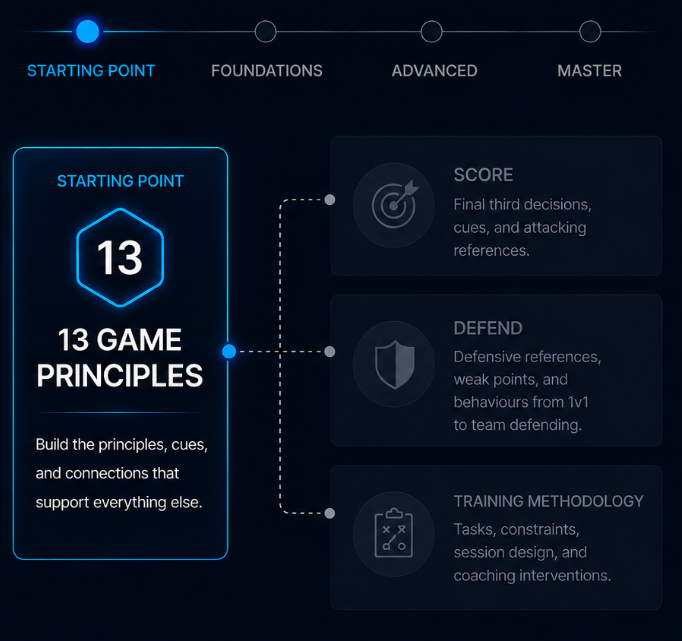
MCH Coaching Map: 13 Game Principles is the starting point, linked to the Score, Defend and Training Methodology families.

Development levels: Starting point (current), Foundations, Advanced, Master. Starting point — 13 Game Principles: build the principles, cues, and connections that support everything else. It connects to three game families. Score: final third decisions, cues, and attacking references. Defend: defensive references, weak points, and behaviours from 1v1 to team defending. Training Methodology: tasks, constraints, session design, and coaching interventions.

Development levels: Starting point (current), Foundations, Advanced, Master. Starting point — 13 Game Principles: build the principles, cues, and connections that support everything else. It connects to three game families. Score: final third decisions, cues, and attacking references. Defend: defensive references, weak points, and behaviours from 1v1 to team defending. Training Methodology: tasks, constraints, session design, and coaching interventions.

The problem

Coaches collect ideas. Organizing them is harder.

You watch games, read analysis, and consume tactical content. The ideas make sense. But when it is time to give a player a clear reference or design a session around a specific behaviour, the connection is not always there.

You understand the concept.
But the player still needs a clear reference.
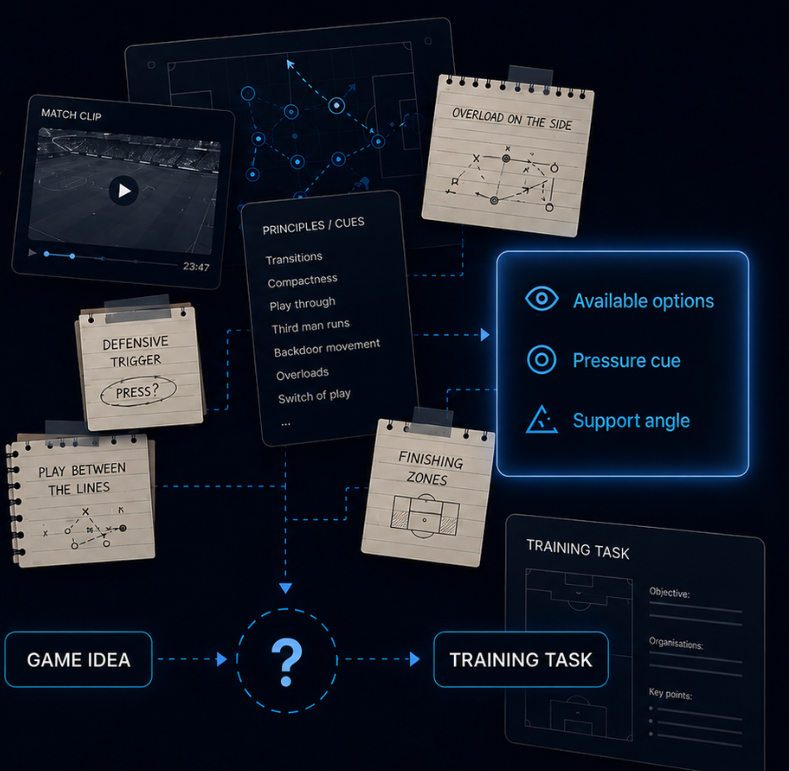
Game idea ? — the missing connection Training task

The framework

From game situation to player reference — in five steps.

13 Game Principles helps you organize what happens in the game through clear principles, cues, and behaviours — so players know what to recognize, when to decide, and how to adjust.

The goal is not to memorize concepts. The goal is to make the game easier to read, coach, and train.

  1. 1 Game Situation Player wants to receive under pressure.
  2. 2 Principle Create Options to Receive Individual Principle
  3. 3 Cue / Reference Defender’s blind spot Space that supports the possessor
  4. 4 Decision / Action Move into a position that supports the possessor. Occupy the blind spot. Create a receiving option.
  5. 5 Training Application
    • Task
    • Constraint
    • Correction
  1. Game understanding
  2. Player reference — current phase
  3. Training application

What you’ll learn

What you’ll be able to do differently.

The course helps you build a clearer way to see behaviours, explain references, and connect principles to the training field.

  1. 1 Give players clearer references Turn tactical ideas into cues players can recognize during the game. Cue / ReferenceRecognize the blind spot before receiving.
  2. 2 See the game through principles Understand situations through clearer individual, collective, and final third behaviours. Reading by principle, not by play.
  3. 3 Connect behaviours across the game Understand how individual actions, collective relationships, and final third decisions influence each other.
  4. 4 Coach with more specific corrections Move from general feedback to corrections connected to the behaviour you want to improve.
    • ObservationArrived late to support.
    • CorrectionAdjust timing of support.
    • EffectBetter angle, more options.
  5. 5 Bring the framework into training Use the principles to design tasks, constraints, and interventions with more intention.
    • Task
    • Constraint
    • Correction

Starting point — MCH Coaching Map

13 Game Principles is where the MCH Coaching Map begins.

The principles framework that connects the game, player decisions, and the training process — through individual, collective, and final third behaviours.

  • 4 Individual Principles
  • 4 Collective Principles
  • 5 Final Third Principles
Image placeholder — swap for the real screenshot
Starting point 13 Game Principles
  • Individual behaviours Recognize the cue and decide the action.
  • Collective behaviours Connect roles, references, and advantages.
  • Final Third behaviours Recognize, create, and finish advantages near goal.
  1. Starting point — current level
  2. Foundations
  3. Advanced
  4. Master